
From Displacement to Deportation: Why Housing Justice Is Immigration Justice
Housing Justice Is Immigration Justice

At CLVU, we know that housing justice is immigration justice. A significant part of our base are neighbors who were displaced from their home countries due to U.S intervention. Yet Black, brown, and disenfranchised immigrants in the United States have been disproportionately met with displacement here in their new homes as well: CLVU members who were forced to leave their home countries now continue to face evictions, unaffordable rent increases, and undignified conditions in their homes in Massachusetts. Many of the same people in the CLVU community are also battling a daily fear of being stereotyped, kidnapped, and deported – but everyday choose to face that fear to go to work, provide for their families, and organize for their right to remain in their home. How are you organizing for justice at home or at work?
Although we are all feeling this tense political moment in different ways, we need to be by the side of our neighbors who are feeling the fear run through their neighborhoods. Deportation and detainment are, of course, horrible forms of displacement. Evictions, deportation, detention, and violent policing practices all rely on fear– and right now, the communities we organize in are afraid of answering the door, and children are watching their families get ripped apart. We are living in a dehumanizing time in which immigrants, human rights activists, and organizers are being targeted by federal powers. But in neighborhoods across Boston, people are organizing. Although it’s scary, more than ever we need everyone to recommit to courage, build momentum, and activate our people power… together we say “ICE OUT!”
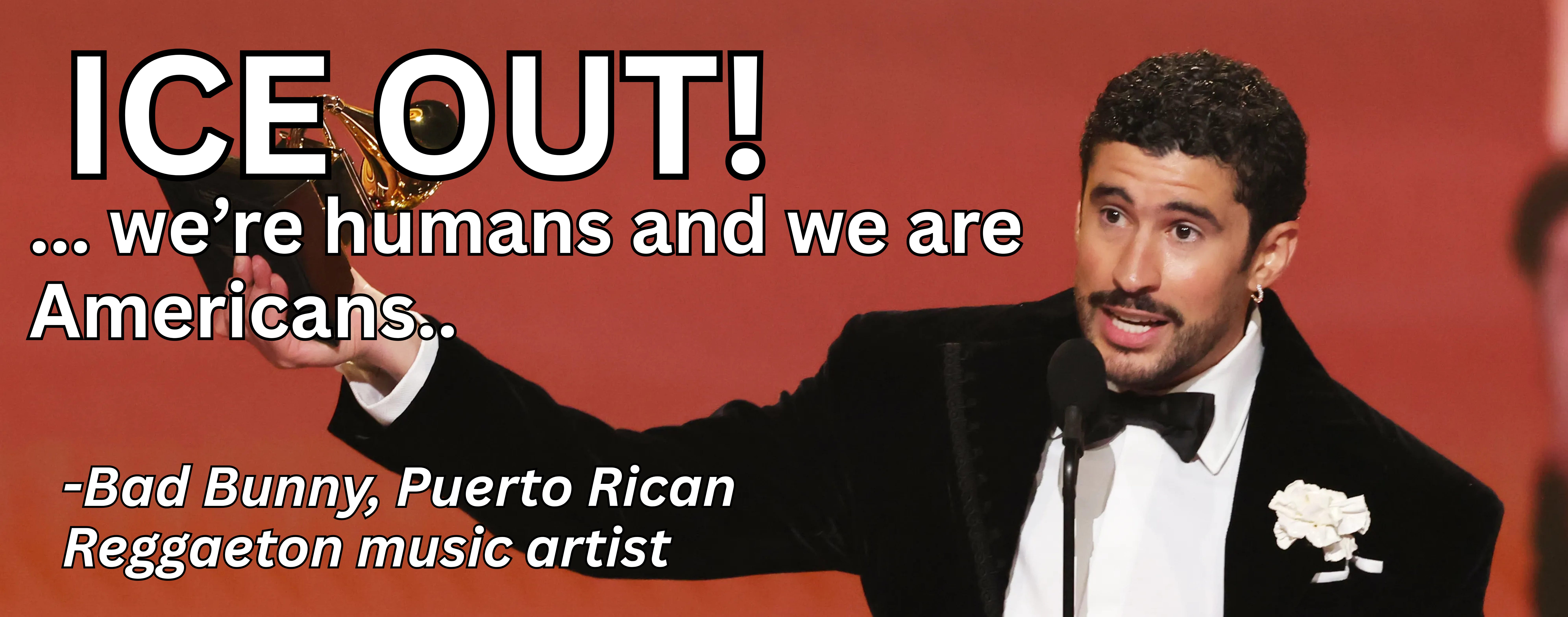
CLVU Members Speak Out
Read pieces of courage and testimony from the CLVU community who are feeling this anxiety firsthand.
One of our longtime members, a grandparent who has lived in this community for decades, described this moment with a mix of heartbreak, disbelief, and anxiety.
“This moment doesn’t even have a name,” they told us. “This fear feels unprecedented, like something that will be studied in documentaries years from now. I love this country… and I’m sure the racists love this country too... So if you truly love a country, why are you violating its Constitution and attacking its people who contribute to the community and economy? What hurts and enrages me most is watching someone like our president with a criminal record blame immigrants for being criminals. I’m just a grandparent who doesn’t want to work hard anymore… I’m tired, this rent is too high and everything is too expensive… y peor there is no work.”
They spoke about the emotional and physical toll of living under constant fear of a political attack. “There’s no peace. There’s no mental health. People are getting sick, suffering from depression, high blood pressure, and worsened heart conditions from all this extra stress. It’s also so hard to find work… I’m barely keeping up with my recently negotiated rent because I’m jumping from one cleaning gig to another. And when we do find work, we accept work in undignified conditions and essentially what are low wages… immigrants like me are forced to accept low prices because we need the gig, I need that pay, any pay to survive and pay rent.”
For directly impacted immigrants, fear has been constant, and home is no longer just a shelter; it has become a frontline for displacement. “Immigrants have always been the workforce of this country. This country is a mosaic of immigrants. The people who say nothing is happening are the US citizens who’ve never experienced racism. I live watching the news day and night just so I can track what lies are being told now. I see or hear about the disappearances happening in the streets, and it doesn’t always make it onto the news. And every day I ask myself, what will happen if ICE takes me?”
They described the crushing weight of uncertainty… the uncertainty of people who have lived in this country for 20, 30, even 50 years being detained over minor infractions from decades ago, like a speeding violation, are not grounds to consider deportation. Nothing justifies deportation and family separation. “Where are the laws? Because I only see this claim of Kings,” they asked. “No lawyer can minimize this pain. It’s not right to see immigrant rights be destroyed every few weeks by our government. We are honest, hardworking people, and yet we are treated worse than dogs.”
They know about community protections. They know about LUCE and ICE Watch, about calling LUCE when there is an ICE sighting. But even that does not erase their fear. “When I saw what happened to citizens like Renee Good and Alex Pretti,” they said, reflecting on recent violence, “I wondered…what happens when there are no cameras? How are people treated when no one is watching? It’s terrifying when undocumented people and or anyone is detained. But it’s even more frightening to think of what could happen in detention centers.”
Their fear extends beyond themself and they also reflect on their grandchild.
“My grandchild came here as a child. They received a Social Security number. They were close to getting residency. All the paperwork was submitted. And now, a lot of immigration processing is frozen or is almost a decade behind. My grandchild will graduate from high school soon. They dream of becoming dentists. My grandchild is at the top of their class and is invited everywhere for academic awards. But without residency, how can they afford college? University is so expensive, and more expensive for undocumented youth. How can they continue their dreams?”
Their voice softened as they spoke about the new generation of youth no longer having access to receiving DACA (since Trump 1.0 destroyed DACA in 2017) and the pathways that once gave families hope. “I am older,” they said quietly. “But what about my grandchild? What about the thousands of young people with professional dreams? What future are we giving them? Are they also going to be forced to work cleaning jobs that I had to suck up and endure?”
“Everything feels desperate. Rent is high. Work is unstable. I’m sometimes scared to go to meetings. But I still send people information. I tell them about the weekly eviction defense meetings. I share where to find food at food banks. I can’t do everything I used to do as a leader at CLVU, but I can at least help that way.”
Their testimony reminds us that fear does not erase dignity. Even under pressure, even in the face of uncertainty, our elders continue to organize, inform, and care for others. And that, too, is courage.
Another member, who is Haitian and whose community is directly impacted by the recent TPS ruling, shares their reflection:
“I’ve lived here for years,” one Haitian member shared at a recent community meeting. “I work. I pay rent. My kids go to school here. But everything in my life has the word temporary attached to it.”
For Haitians, Temporary Protected Status (TPS) meant the ability to breathe, not fully, but enough. It meant work authorization, a signed lease, and the chance to plan more than a few months ahead. But living under TPS also meant carrying the mental stress and anxiety of knowing that stability via TPS could be canceled at any time. When news spread that TPS protections could be terminated, fear of displacement fueled feelings of stress and anxiety. But there was a huge sigh of relief when a federal U.S. District Judge Ana Reyes in Washington, D.C. temporarily blocked Homeland Security Secretary Kristi Noem’s decision to terminate TPS for Haitians in the US.
Although the termination of TPS for Haiti was temporarily blocked, the member shared that “It feels like the ground is moving again”.“How do you build a future when the ground keeps shifting? I already lived through an earthquake in Haiti. Why does this instability happen again in Massachusetts?”.
That instability doesn’t stay in the headlines. It shows up at the kitchen table, in lease renewals, in conversations with landlords. When your status is uncertain, signing a lease feels risky. Some landlords hesitate to renew. Some demand additional documentation. Some exploit the uncertainty. Although federal fair housing law protects tenants regardless of immigration status, fear makes it feel risky to assert those rights. “How do you fight eviction when you’re fighting deportation too?” they asked “the fighting never stops but at least I’m not alone”. Temporary protection status (TPS) nor the Deferred Action to Childhood Arrivals (DACA) does not provide a pathway to citizenship therefore not guaranteeing permanent safety. But committing to growing our people power and collectively strengthening our organizing muscles is what we will build towards community defense and liberatory practices.
When we organize together, fear loses its power. In this political moment, CLVU remains determined in our commitment to anti-eviction and housing justice organizing, because safe and stable housing is critical to dignity, safety, and belonging. We continue to host regular eviction defense meetings where organizers, movement lawyers, and law students support and engage hundreds of community members in English, Spanish, and Haitian Kreyol to learn their basic housing rights. These meetings create space for tenants to identify collective organizing strategies to resist evictions and unaffordable rent increases, and to fight foreclosures across Boston and Brockton while building working class power.
At the same time, we recognize that housing stability cannot exist where immigrant communities are being targeted and terrorized. That is why CLVU is part of the LUCE network, with many members and allies from our base participating in ICE Watch efforts to keep the communities where we organize safe. Through coordinated monitoring, rapid response, and community education, CLVU members are working alongside partners to ensure neighbors are informed, supported, and not left isolated during ICE enforcement. We do this because housing justice and immigration justice are inseparable: when fear of deportation keeps tenants from asserting their rights, housing insecurity, evictions, depression, and worsening health become more looming.
Everyone deserves a home without the threat of eviction, intimidation, or deportation. Organizing tenants, building collective power, and standing with immigrant families strengthens our neighborhoods. Our vision at CLVU has always centered collective safety, in which everyone has the right to exist in freedom without fear of displacement or deportation, regardless of immigration status. At CVLU, we fight for racial, social, and economic justice and gender equality by building working-class power. So together, we will continue to organize in our communities’ defense, organize to end the occupation of our communities, and fight for a future where each person has the right to food, housing, health care, education, meaningful employment and the right to exist in freedom without the fear of displacement or deportation.
Get Involved:
Support LUCE’s ICE watch work in Massachusetts donate today or find a LUCE ICE watch training near you. Check the LUCE website for more information.
Come to weekly CLVU meetings in Jamaica Plain and East Boston and build working class solidarity and power with us.